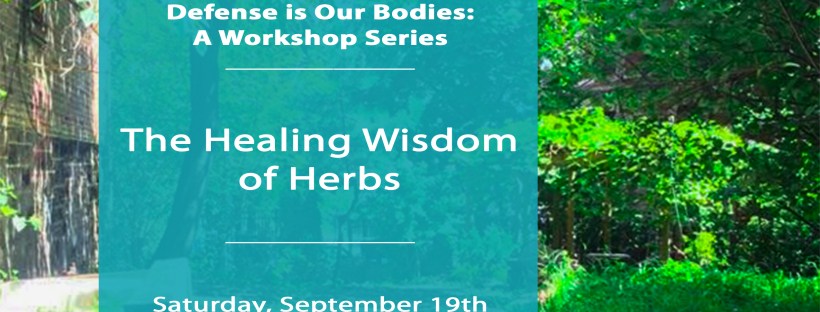
The Healing Wisdom of Herbs – Update!

We’re excited to share more details on The Healing Wisdom of Herbs, the next session of  our workshop series!

The session will focus on identifying herbs, healthy living, and much more in collaboration with a community garden in Harlem.  The facilitator will be Core Sister Glenda Ullauri, who’s work involves intergenerational programming in urban agriculture and food justice that is guided by the unconditional love for our pachamama and compassion for all living things and ancestors.

This session will be very similar to last summer’s Cultivation Circle, which can you find a clip of below. More details can be found in the flyer below and on the Eventbrite page.

Be sure to reserve your spot at this session here.

We look forward to seeing you!

Much love,
the SCC

workshop3flyer

We Need to Focus on Black Joy Just as Much as Black Liberation

The Black experience in the United States has always been paradoxical in nature, as our historical memory knows that it has been one of constant struggle. However, in the face of the violence, poverty, trauma, systemic oppression and death, we have continued to thrive.

But after rolling to protests, having emotionally charged conversations with White “allies,” and witnessing how many folks on my newsfeed were more concerned about Cecil the Lion than Sandra Bland, I’ve been reminded that be Black in America is to be tired. As it’s been said time and time again, being Black in America is exhausting – we’re supposed to just play sports, make White America laugh or sing along to (apolitical) music, and stay silent while the heteropatriarchal White supremacist system kills us. All to diminish our spirit and potential.

Society currently presents the intersection of thriving and surviving as a challenge; an impossible aspiration that seems less and less obtainable when bombarded by the mainstream news cycle. Systematic hurdles and barriers exist at every turn and dictate how we should be living our lives and imply that we should not aspire for more. As the medical data confirms that Black folks and other people of color suffer from generational trauma in the forms of high blood pressure, heart disease, strokes, diabetes, and other preventable illnesses, we are forced to buy back into a medical system that has historically harmed us. The capitalist structure is not truly designed for wellness, in fact, it invested in perpetuating illness as a means of profit.

While there is hope in holistic medicine and campaigns encouraging us to get physically healthy, such as Black Girls Run! and FLOTUS Michelle Obama’s Let’s Move!, we cannot afford to solely focus on the body. We have to place an emphasis on the spirit and what (collective) joy looks like for us as individuals and as a people. In this (new) movement for Black liberation, there has to be an emphasis on celebrating and cultivation Black joy as well. Black liberation has a long history – from the liberation theology born in the Civil Rights Movement, to the radical teachings of Assata Shakur and the Black Liberation Army – and proves to be more relevant than ever in our movements. Whether you seek liberation in the church or through direct action, can we truly liberate ourselves as a people if we do not acknowledge and emphasize the role of sustaining ourselves in mind, body and spirit?

If we are going to have Black liberation, we must continue to strive for wholeness and wellness in the face of all the ills of the world. For me, Black joy is both the collective experiences and the personal triumphs of our people. Black joy looks different for everyone and can be found in a variety of forms; in simple acts of self-care, spending time with loved ones, or indulging yourself by working on those projects you’ve been putting off. Starting a journal, getting to know your creative side through a form of art, developing a circle of sisters, or taking yourself out on the town. Even if it’s just five minutes, making the time to sit down to (re)discover what brings you happiness is a liberatory act.

My Black joy is a work-in-progress, but right now, it appears when I’m soaking up the sun and marveling at the glow my melanin gives me. My joy is found in hearing the laughter of my family and the way my heart swells when I see the look of love I have for my partner reflected back at me. My Black joy is grinning at little girls with their natural hair out on full display and seeing their little spirits stand so tall.

This Black joy, in spite of all that we face, is revolutionary. The ability to create and hold space for our happiness as a people is not new, however. When slaves could not be legally wed, the African tradition of jumping the broom was revisited. This is not to say that this made the union legal in the eyes of the legal system, but this act of remembrance and celebration, in the face of the horrors of slavery is one liberatory act of Black joy that can be found in history. In today’s actions, our Black joy can be seen in other ways.

Burning sage and incense during a protest, or creating an altar for those who we have lost to violence is an act of Black liberation. Deciding when and how we want to engage in the conversation on Black lives with allies and even those in the movement is a radical act. The love we have our sisters on the vanguard of this movement, including Bree Newsome, Johnetta Elzie, Alexis Templeton and Brittany Ferrell, and the many others, is one to hold dear as we engaging in liberatory work.

As we continue to affirm that #BlackLivesMatter and encourage everyone to #SayHerName, finding that inner joy and self-love is a vital contribution to the struggle against the constant trauma inflicted on Black people. We may not have the opportunity or space within ourselves to choose happiness everyday, and that is okay. But if we can get to a point where we have more days where we are able to opt for joy then not, we will be in a space of light and love while designing a world where we are not only surviving, but are celebrated.

Marginalization of Women: A Socio-Economic History Summer School Of Women’s Activism (SSOWA) NYC Session One

NEW YORK CITY: To the skepticism of most and to the dismay of some more, there are quite a few matrilineal societies existing today. The most publicized of all can be traced to the Khasi tribe in India, in the state of Menghalaya, wherein children take their mothers’ last names, the youngest daughters inherit the family’s wealth, and newly married men move in with their wives’ families under the guidance of their mothers-in-law. It’s a society that has not fought a war in 2000 years, and yet its strong women-centered tradition is pushing some Khasi men to rebel against it and assert their ‘natural right’ as men, as providers and protectors.

If a society such as this exists, and if such is possible, how come half of the world’s population, women, the source of humankind’s continuity, have become marginalized and oppressed, and had, only a little more than a 100 years ago, started to fight for their rights and claim their place in the world?

The first session of AF3IRM’S Summer School of Women’s Activism held on July 11, 2015 in Manhattan, tackled this question and discussed the history of how women have been subjugated, albeit in an insidious manner, through the advent of surplus production, leading us to where we are now socio-economically– the poorest of  the poor being women.

AF3IRM member and renowned novelist Ninotchka Rosca, who led the discussion, introduced the participants to the Goddess, who, for 250, 000 years, had ruled people’s spiritual activities as opposed to the male-dominated religious and spiritual dominations of today. The goddess was a fixture in ancient societies and was suddenly erased from history. This phenomenon stemmed from an overwhelming insecurity enveloping men during the time women invented agriculture, gaining the knowledge to grow and produce food, which had not been attainable before.

According to Rosca, approximately 10, 000- 15, 000 thousand years ago, “human beings bonded together mainly for the preservation of the species.” It was a binary setup: men hunted and women stayed home, not just to raise kids, but to domesticate plants and animals to supplement the food supply. These Neolithic communities reaped the benefits of this skill, women, the farmers, gained value “as they learned to exercise further control of nature.”

It was the invention of the plow in 4500 BCE, however, that led to the marginalization of women from food production. Women did not have the upper body strength to plow the land. This advancement gave birth to surplus food, which meant something of value, a commodity, giving birth to the concept of private property and hierarchy within these communities. Men who acquired the most amount of surplus food, in turn, acquired power. Though sidestepped by the plow, women still possessed valuable farming knowledge, and along with circumstances establishing the accumulation of food, they, unknowingly, also assumed the shape of property and commodity. Thus, the establishment of patriarchy.

The implementation of hierarchies in these societies resulted in restrictions on women’s sexuality and reproductive rights. Alliances were forged through arranged monogamous marriages and men were suddenly making decisions on how to utilize women’s bodies for child-bearing, pleasure, etc.  Rosca added that women as currency and as tribute became a prevailing perception that it led to a vicious and inhumane transaction that we now call trafficking.  Consequential to the establishment of private property, Rosca reinforced, “was violent restrictions on women’s rights.” No one could have predicted that “women’s work and women’s bodies could be disposed of by others,” Rosca said.

Justine Calma, also from AF3IRM, opened the discussion on sexism and intersectionality with activities that depicted how women are constantly portrayed as property- being sold, married off to men they hardly know-  even in popular media.  Calma pointed out that women-of-color’s struggles always come in intersections of gender, race, and socio-economic status among others.

Guest facilitator Veronica Agard  of Sister Circle Collective, discussed in-depth how intersectionality works.  “Intersectionality,” according to Agard, was coined by African-American feminist Kimberly Williams Crenshaw, bringing to light various factors affecting women-of-color’s everyday life.  Citing examples of how she personally encounters intersectionality in the form of cultural patterns and stereotypes, how discreet black women are accused of talking white, how her being a fan of the show Game of Thrones, known for sexist content, makes her navigate between resistance and innocent admiration, Agard succeeded in contextualizing intersectionality for those new to the concept.

Agard went on to touch on the ongoing violence against black women, of which police brutality is a main agency. AF3IRM NYC and Sister Circle Collective (SCC) joined the Millions March NYC a few months ago, following the deaths of two black men at the hands of the police. Chanting the names of the fallen black trans and cis women, whose names and the tragedies that befell them, have not been reported in the media, SCC and AF3IRM NYC were able to veer the discourse towards black women who also perished at the hands of authorities. AF3IRM NYC and SCC led #FeministsOnTheMove, an online and offline campaign that broke this disturbing silence. #FeministsOnTheMove helped turn the spotlight to these hundreds of women, to whom cultural stereotypes, gender and race had been a fatal mix.

The session closed with a workshop on documenting everyday sexism and other signs of patriarchy, which was facilitated by Calma, who is also a journalist. The participants were asked to answer the WHO, WHAT, WHERE, WHEN, HOW and WHY of their personal experience with sexism.

#WelcomeToTheGRC – We Did It!

Gender Resource Center Campaign's avatarGender Resource Center Campaign

Community–

‪#‎WelcomeToTheGRC‬!

WE DID IT!!!!!

With a final vote of 19 to 3, in favor, the GRC Campaign is that much closer to having a space to provide vital services to survivors on campus. We sincerely thank the USG Senate for this favorable decision and we look forward to working with you to make the GRC a physical reality.

Thank you so much to everyone who packed the room, both in real life and in spirt. Your presence has had a huge impact throughout the campaign, but especially today. We are forever grateful for your support.

We’re hoping to have a get-together in the next week or so to be able to celebrate, get to know, connect with everyone.

In the mean time, spread the word about this victory for CCNY!

Cheers to all there is come.

With infinite gratitude,
the Gender Resource Center Campaign;

CCNY Anthropology Student…

View original post 28 more words

This Is It – USG to Vote on the Creation of a GRC on 9/3

Gender Resource Center Campaign's avatarGender Resource Center Campaign

Community–

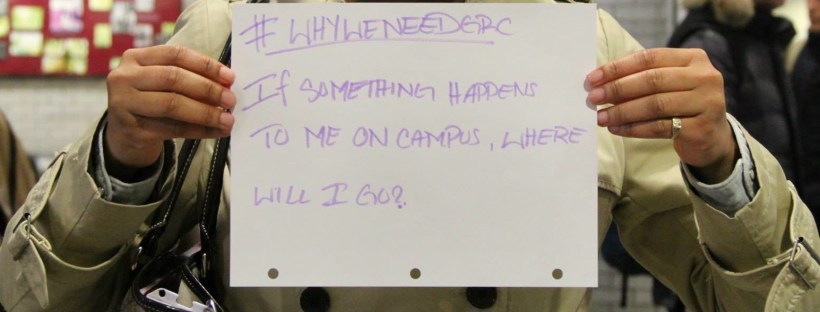
The Undergraduate Student Government of City College will be voting on GRC’s ability to have space in the new building. This is crucial for our efforts and we would like to invite all supporters, allies, and organizers to support us and tell USG #WhyWeNeedGRC.

Folks who show up to the event, we’re asking you to make signs explaining why we need GRC, and to hold them up so many voices and experiences are represented as possible. This is huge! and your support is crucial to us successfully securing the space to make our campaign into a reality.

In solidarity,

The Gender Resource Center Campaign;
CCNY Anthropology Student Association
CCNY SAFER
Government & Law Society
Roosevelt Institute at City College of New York
Sister Circle Collective
Students For Educational Rights
Student Mental Health Initiative
BEAM CCNY

View original post

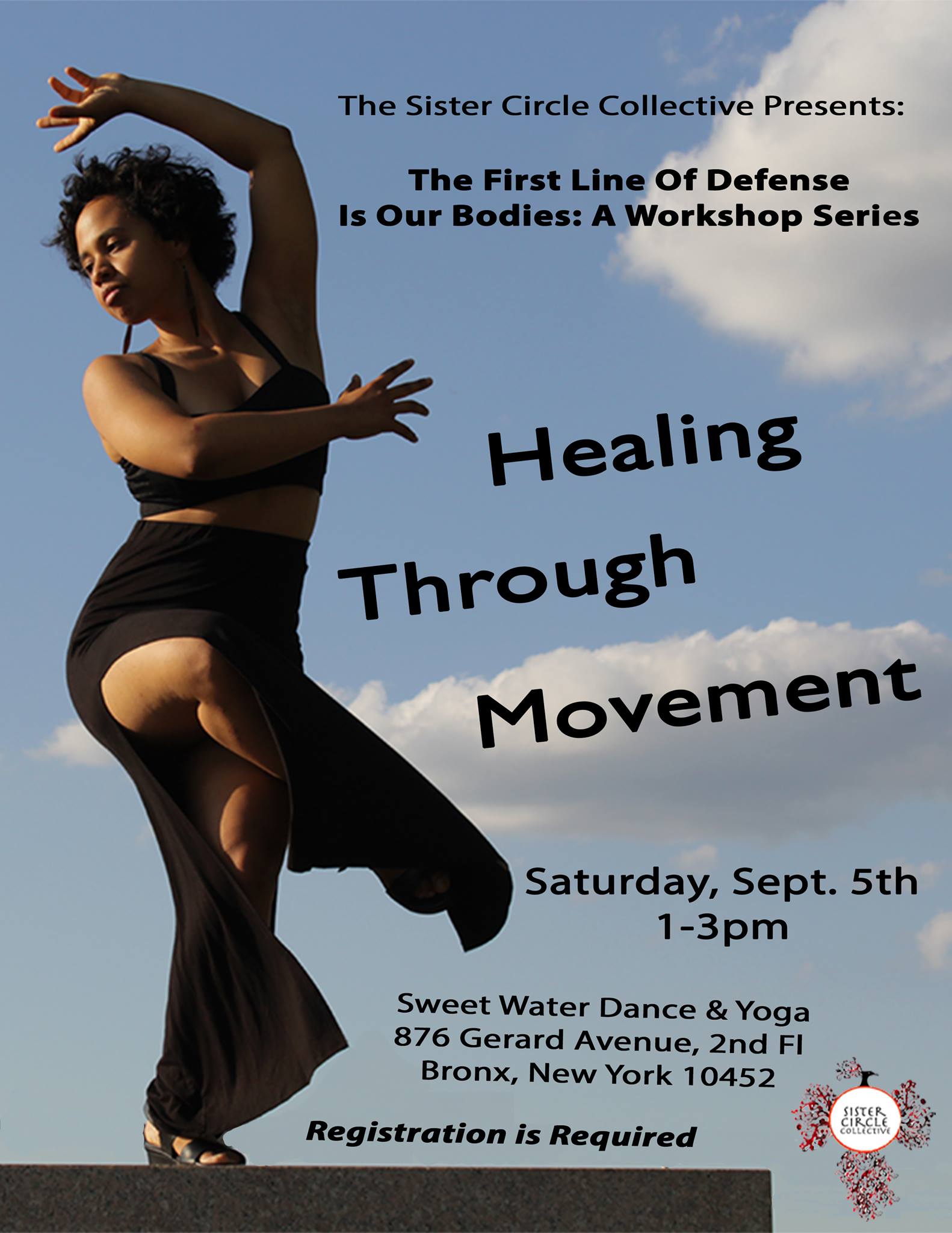
Healing Through Movement Workshop Update

We’re thrilled to share that the facilitator for Saturday’s workshop is Rosangel Perez of the Perez Sisters!

The Perez Sisters are the owners of the beautiful metaphysical boutiqueBotanikal, where they offer an array of services, sell stones, incense, and more. Rosangel Perez is a shamanic movement coach and the radio host of Cafecito Break.

The session will focus on gentle easy movements, breath work, chanting, laughter, and meditation enhanced by a music selection intended to “get you out of your head” and into your body. This class is not based on technique– it’s foundation and intention is gratitude, feeling, and acceptance of your sacred sexy self.

For more details, secure your spot for this workshop by registering here.

Metrocards are available for those in need. We look forward to seeing you!

Healing Through Movement Flyer

The First Line of Defense Is Our Bodies

THE FIRST LINE OF DEFENSE IS OUR BODIES: A WORKSHOP SERIES

Join us for our first ever workshop series!

<><>BACKGROUND<><>
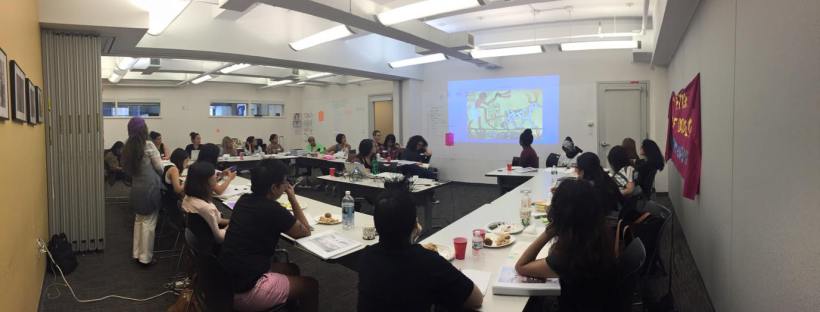
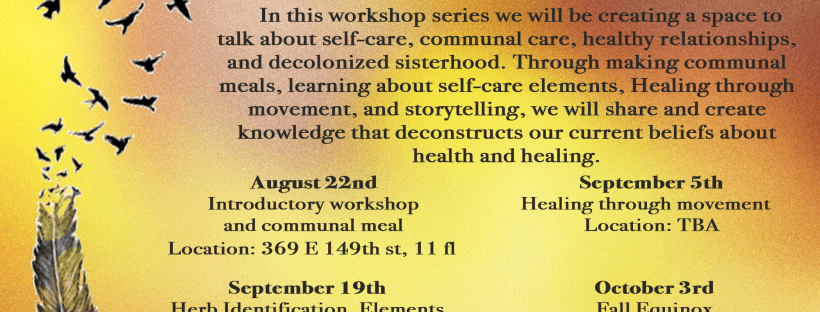
We believe in a holistic health and healing perspective; health and healing is not just about an individuals physical body, but also their mind and spirit in relation to the communities and spaces they find themselves in. In this workshop series we will hold space to talk about self-care, communal care, healthy relationships, and decolonized sisterhood.

Each workshop in the series is focused on a different aspect; communal meals, learning about self-care elements, healing through movement, and storytelling. We aim that all participants will share and create knowledge that deconstructs our current beliefs about health and healing.

<><>DETAILS<><>
All of the workshops are free with an RSVP!
All workshops are for women and girls unless otherwise specified.
We have metrocards available for those in need! Please email us at sisterscirclecollective@gmail.com for details.
Free meals will be provided during the all of the sessions.

Questions? Call: 507-339-4469

<><>SCHEDULE<><>

August 22nd: Introductory Workshop and Communal Meal
Location: 369 E 149th st., 11th fl (BX)
Sign up here: http://www.eventbrite.com/e/the-first-line-of-defense-is-our-bodies-a-workshop-series-tickets-18161602843

September 5th: Healing Through Movement
Location: TBA
Sign up here: Link coming soon

September 19th: Herb Identification and Elements of Self-Care
Location: TBA
Sign up here: Link coming soon

October 3rd: Fall Equinox – Final Workshop
Location: TBA
Sign up here: Link coming soon

<><>GRATITUDE<><>

Thank you to Citizens Committee for New York City for making this possible!